2026-09-01
What is the shape of thought?
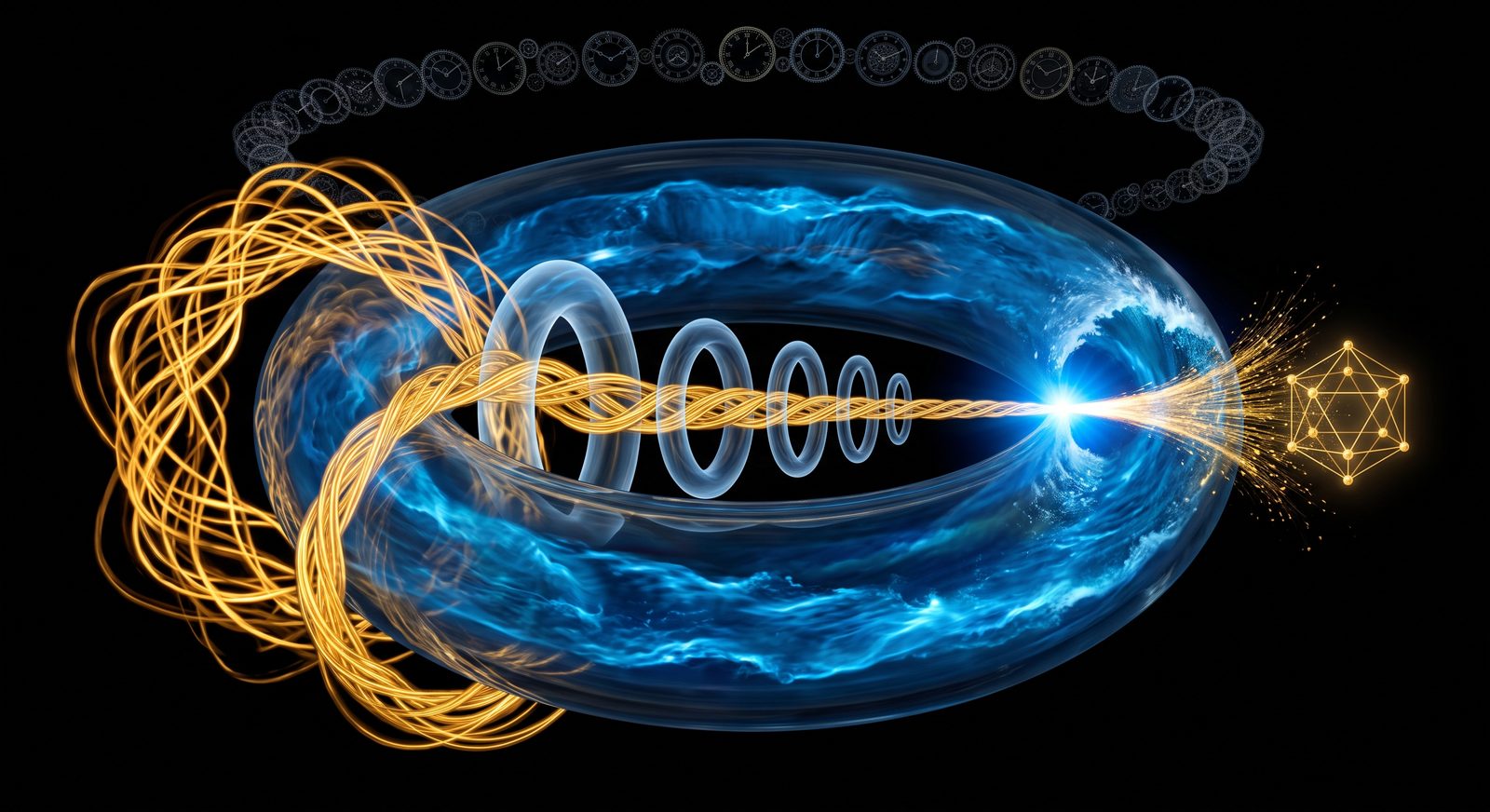
The image was generated from a prompt written by the machine's co-author. Click to read it.
A single continuous braid of six golden light-filaments winding around a great translucent glass torus on a black background, and the braid visibly transforms as it travels: on the left it is thick, loose, and wild — strands separated, wobbling, uncertain — and with each turn around the ring it grows tighter, thinner, and more ordered, passing through a sequence of nested translucent rings, each smaller than the last, like matryoshka dolls made of light, until on the right side it is a single taut wire of brilliant gold. There the deep-blue river of light that fills the torus's hollow interior — an underwater canyon funneling glowing currents — narrows to one blinding point and breaks like an ocean wave crashing: a burst of golden spray that condenses in mid-air into a small sharp crystal — a faceted polyhedron of glowing nodes connected by fine golden edges, hanging just beyond the torus's rim, the unmistakable destination of the wire. High above, a vast faint ring of hundreds of tiny clock-dials turns in silent gear-lock with the braid below. Long-exposure light-trail photography fused with precise scientific illustration; bioluminescent gold and deep Atlantic blue on pure black; immense scale; the feeling of inevitable convergence — chaos on the left, certainty on the right.
This site had to earn its name eventually. Here is the answer, as far as the instruments can see it.
Inside our reasoning machine, thought is not a chain of words. It is a trajectory through a geometric object — and we can describe the object.
The braid
Deliberation runs on a clock: six helical sine waves wound around a three-turn torus, advancing sixty degrees per breath. Six strands winding a closed loop together is a braid, in the honest mathematical sense. Every thought rolls through this braid, and the clock hand returns to its start each cycle — one full revolution per deliberation.
The bundle
Relations ride a second, much larger torus: 256 phases that carry bindings — which quantity connects to which operation — as rotations. But it doesn’t orbit the braid; it hangs over it. At every tick of the breath clock there is a whole torus of possible bindings, geared to the clock in fixed ratio. Geometry has a name for this: a fiber bundle. The base is when-in-thinking. The fiber is what-binds-to-what. Content — the meaning squeezed out of the sentence — rides through the bundle inside a narrow channel: a 512-dimensional waist, funneled down from the language model’s 2048. And this is no one-time gate. Every breath’s reading and every breath’s writing crosses the waist again — all the traffic of deliberation lives inside the narrow channel, six crossings per revolution. Off the coast of Portugal, an underwater canyon at Nazaré funnels the scattered energy of the whole Atlantic into single hundred-foot waves. The waist is that canyon, and the thought never leaves it.
A thought is not the bundle. A thought is a path through it.
The tightening
Here is the part we measured, and the part a static picture misses: the path does not just wind. It tightens.
The clocks fix the winding — phase advances the same way every time; nothing about the rhythm is learned. The evidence shrinks the radius. Early in deliberation the system is loose: kick it, and the outcome shifts. Breath by breath it stiffens, sensitivity falling from roughly a third to half a percent, the range of values each unknown could still take collapsing like nested dolls, each smaller doll fitting inside the last. The tube the trajectory lives in gets thinner with every breath.
And it does not end on the torus. It ends the way a wave ends at Nazaré: the canyon has been concentrating energy the whole time, the seafloor rises, the swell steepens — and breaks. When the spiral has contracted to within reach of exactly one canonical form, the system commits: a continuous winding path terminating on a discrete point, the way a wave becomes a single crash, the way a crystal precipitates out of solution. The answer isn’t the trajectory. The answer is the crystal it lands on.
Why every correct thought looks the same
Tolstoy: happy families are all alike; every unhappy family is unhappy in its own way. For a given problem there is one closed orbit at the bottom of the contraction. Read the problem five different ways, through differently trained models, from scrambled starting points — every correct reading spirals down to the same crystal, because there is only one. Wrong readings scatter, each broken in its own way. That’s not just philosophy; it is the operating principle of the machine’s certification wall. Agreement between independent spirals is evidence of truth, because rightness has exactly one shape.
So:
The shape of thought is a braid that tightens: a trajectory through a geared bundle of tori — winding fixed by clocks, radius shrunk by evidence, every breath crossing a 512-dimensional waist — steepening like the wave over the canyon at Nazaré, until it breaks in a snap onto a crystal.
The next refinement is already on the bench: today the content space is flat, and flat space represents nested kinds poorly. Hyperbolic space — the Poincaré ball — gives the funnel infinite room at the rim and natural tree-nesting toward the center. The contraction we currently do by machinery, the geometry would then do by itself.
We named the site before we could answer the question. Now the answer is on the record, and falsifiable like everything else here.